Stealthpath

OT cybersecurity

Every facility needs cybersecurity visibility. Most have limited or none.

Stealthpath challenged every part of the value chain — cost, complexity, connectivity, risk — to bring it to the facilities that enterprise platforms were not built to reach.

The result is a platform that scales from a single facility to a national program — without scaling the cost, the complexity, or the risk.

Our capabilities

Platform view Stealthpath See, capture, and operationalize facility evidence.
01 Inventory Asset & Device Inventory
02 Baseline Network Baseline & Segmentation
03 Monitoring Continuous Monitoring
04 Capture Incident Data Capture
05 Validation Maintenance Validation
06 Reporting Audit-Ready Reporting
07 Export SIEM Integration & Export

Water treatment. Dams. Power stations. Smart cities infrastructure. Manufacturing.

Operating with limited or no cybersecurity visibility.

The pattern repeats across every industrialized economy. The World Economic Forum calls it “a dangerous blindspot.” CISA describes the operators as “underserved and under-resourced.” The industry has a term for it: below the security poverty line.

Enterprise cybersecurity was built for organizations with dedicated teams, always-on connectivity, and six-figure budgets. That model structurally excludes the facilities that need it most — not because the technology is wrong, but because the economics, the deployment model, and the operational assumptions don’t translate.

StealthPath was built specifically to close that gap — with practitioners who came from these environments, designed inside the constraints, tested in the field, shaped by the operators who run these facilities every day.

280,000

Facilities in the United States alone.

74 %

cite cost and complexity as the primary barrier to OT cybersecurity.Gartner, 2024

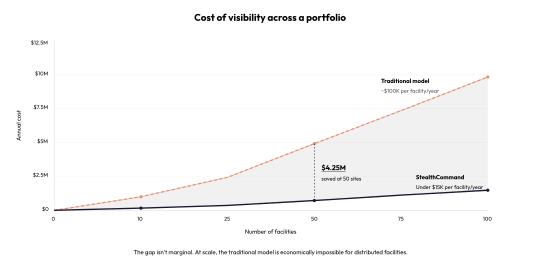
What visibility used to cost

The cost, complexity, and time required to assess a facility determined how many got assessed.

The traditional approach required specialist teams, weeks on site, network modifications, and six-figure budgets. For facilities operating below the security poverty line, that model didn’t scale down — it simply didn’t arrive.

Category
Traditional
StealthCommand
Timeline
Weeks per site
Hours
Personnel
Specialist consultants
Facility operators
Training
Extensive
Minutes — six clicks
Connectivity
Cloud or SOC required
Fully air-gapped
Pro services
Required
Eliminated
Net mods
Required
Eliminated
Annual cost
Six figures
From under $15,000

Visibility without attack surface.

Passive

Zero packets injected. Zero agents installed. Zero impact on network performance. StealthCommand listens. It never transmits.

Air-gapped

Not “air-gap compatible.” Native. No external connection at any stage. The product doesn’t degrade without connectivity — it was built for it.

Secure

Every unit is DISA STIG hardened. Cryptographically verified. Hardware ships sealed, opened in the client’s presence.

Data sovereign

Data remains under client custody at all times. No cloud. No phone home. No exfiltration path exists in the architecture.

Built with practitioners. Proven in the field.

Sole-source Federal contract

U.S. Army Corps of Engineers. Awarded sole-source — multiyear, options exercised.

0 Added threat vectors

Deployed without introducing a point of connectivity, an agent, or an external dependency.

<1hr To operational

Deploy, verify, visibility. No external consultants. No network modifications.

1 Capture. Multiple uses.

A single passive deployment feeds discovery, compliance mapping, and exercise readiness.

Operational Development to adoption

Field-tested. Validated in multi-agency exercises. Deployed during live incidents. Adopted.

27 Patent assets

12 granted, 15 pending.

Press Releases

No press releases available.

Press releases will be published here.