Approach

How StealthCommand works

Designed inside the constraint. Tested in the field. Shaped by the people who operate these environments every day.

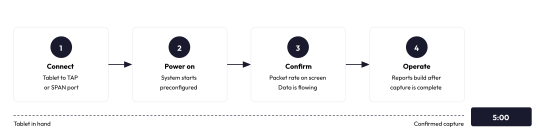
5 minutes from tablet to confirmed capture

Five minutes from startup to packet rate on screen — the operator knows data is flowing. Reports build after capture is complete.

Systems are configured and sealed at the client’s headquarters — no black box, no third-party travel. The client’s existing teams deploy to their own sites. No added personnel, no added cost.

Design Principles

[object Object]

Operator-first

Designed for the people who run the facilities, not the people who sell security services. Six clicks, visual confirmation, operational in minutes.

Economics that don't exclude

Under $15,000 annually. No professional services. No cloud dependency. No specialists required.

Secure by construction

Every deployment is built deterministically — hardened to DISA STIG standards, SCAP-verified, backed by a full software bill of materials. Each release is a complete build, not a patch.

Attested output

Every piece of intelligence is verified at the source, traceable through every step, tamper-evident by design.

Data sovereignty

All data processed in-situ — on the device, at the facility, under the operator's control. No cloud telemetry.

Commercial hardware

Built on commercial off-the-shelf equipment. No proprietary appliances, no vendor lock-in.

What arrives at the facility

Every unit is built through StealthForge — hardened to DISA STIG standards, SCAP-verified, sealed in the client’s presence. The operational stack runs on proven, auditable open-source infrastructure (Kubernetes, Helm, container orchestration).

StealthRecon

Portable and battery-powered. A single operator connects to a TAP or SPAN port, powers on, and begins capture in six steps. No network credentials. No software installation.

StealthVault

Plug and play. Connect to a TAP or SPAN port, configure collection, and it captures continuously. Small form factor, headless, designed to sit in a cabinet and record everything.

StealthAlert

Arrives preconfigured. The whitelist is built at HQ before shipping. Connect it and it monitors for deviation. The operator doesn’t configure it — they respond to it.

From pilot to production

A pilot deployment at a single Army Corps district became a sole-source federal contract. The tools worked in the hands of facility operators without cybersecurity training. The program grew because the data was trusted and the results were visible from the first capture.

More coverage produces better baselines. Better baselines produce sharper detection. Sharper detection produces higher confidence. Higher confidence produces broader deployment.

Every facility that comes online generates structured OT network data — asset inventories, protocol maps, communication baselines. Outputs are delivered in standard formats ready for ingestion by the analytical platforms the client already operates.

Field validation

Multi-Agency Exercise

Exercise rules prohibited vendors from offering tools — teams had to request them. Six of seven departments did. Operators received a configured tablet, tapped into the network, and were operational in under five minutes. Real infrastructure, real OT networks, real compromise scenarios.

Research Validation

The CARS research team at Imperial College London deployed StealthCommand independently. Same result — tap in, six clicks, confirmed capture in under five minutes. Consistent capture, every time, every environment.