What operators do with it

Use Cases

StealthCommand wasn’t designed for a single use case. It was designed for a constraint — no connectivity, no specialists, no budget for enterprise platforms. The use cases emerged from the field.

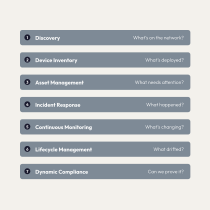
One platform. Seven operational questions.

Seven activity drivers

Every deployment starts with the same platform. What changes is the operational question the facility needs answered. Every use case works fully air-gapped. The data never leaves the facility.

Discovery, device inventory, incident response, asset management, continuous monitoring, lifecycle management, dynamic compliance — all solved by the same platform, all requiring minimal operator training.
Tested capacity — single device [PLACEHOLDER]

What changed when the barrier was removed

Same needs. The barrier was cost, complexity, and time — not awareness.

Category
Traditional
StealthCommand
Asset verification during maintenance
Specialist team, weeks of scheduling, six-figure cost
Operator captures snapshot before and after — minutes
Compliance documentation
Manual spreadsheets, consultants, months of preparation
Evidence generated as byproduct of routine monitoring
Pre-acquisition due diligence
Send a team, scope engagement, negotiate access, wait for report
Configured tablet, network topology and asset baseline in hours
Cross-facility comparison at scale
Independent assessments, inconsistent methods, no baseline
Same platform, same process, same data — direct comparison
OT network documentation
No accurate record. Diagrams outdated, incomplete, or absent
Complete, accurate OT network map — first time ever for many
Maintenance-integrated monitoring
Cyber and maintenance: separate workflows, teams, budgets
Operators use platform as part of routine maintenance process
Organic adoption across teams
Top-down procurement, specialist training, dedicated headcount
Participants at exercises asked for the tool — bottom-up pull

Where it applies

The same platform serves every sector. What changes is the operational context. These are the sectors where the gap is widest.

[object Object]

Water & Wastewater

Critical Infrastructure

160,000+ treatment plants in the US. 70% found in violation of federal cyber standards. SCADA systems running Modbus and DNP3 with no monitoring.

SCADA network discovery · EPA compliance evidence · Treatment process integrity · Chemical dosing verification

Electric Utilities

Critical Infrastructure

Small and medium utilities serving rural and municipal areas. NERC CIP compliance pressure without enterprise budgets. Substations running IEC 61850 and DNP3.

Substation OT baselining · NERC CIP evidence · Firmware tracking · Protection relay monitoring

Military & Federal

Government & Defense

USACE manages 1,500+ critical infrastructure sites. Air-gapped environments with DISA STIG and NIST SP 800-207 requirements. Zero tolerance for cloud-connected monitoring.

Zero Trust validation · DISA STIG/RMF compliance · Cross-facility inventory · Cyber exercise support

Manufacturing

Industrial

Supply chains cascading from enterprise OEMs to Tier 2 and Tier 3 component manufacturers. The most exposed and least equipped.

Production network discovery · Supply chain compliance · Pre/post-maintenance verification · OEM security documentation

Dams & Hydropower

Critical Infrastructure

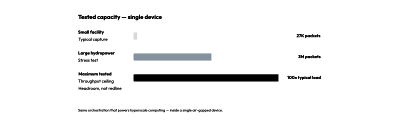
91,000+ dams in the US, 69% under state regulatory responsibility. SCADA with EtherNet/IP and PROFINET. Stress-tested at 3M packets on simulated large US hydropower.

Dam control mapping · Gate/spillway verification · Hydropower monitoring · Federal/state compliance

Healthcare & Pharma

Healthcare & Life Sciences

BMS, medical device networks, pharmaceutical manufacturing lines. FDA 21 CFR Part 11 requires data integrity. Air-gapped monitoring avoids patient safety risk.

Medical device discovery · BMS/HVAC monitoring · Pharma process integrity · FDA/GxP compliance

What the data makes possible

[object Object]

Network topology mapping

Automated visualization of device relationships, communication paths, and network segmentation.

Protocol deep inspection

Application-layer analysis of OT protocols — function codes, register values, command sequences.

Compliance gap analysis

Automated assessment against ISA/IEC 62443, NIST SP 800-82, DISA STIG, and facility-specific standards.

Communication baseline

Normal traffic patterns established. Deviations flagged. The foundation for continuous monitoring.

Asset lifecycle tracking

Equipment age, firmware currency, end-of-life status. Maintenance planning informed by network reality.

Attested data packaging

Captures exported as PCAP with integrity metadata. Provable chain of custody from point of capture.

Executive reporting

PDF for leadership. JSON for SIEM. XLSX for analysis. The right format for every stakeholder.